The Basic Idea: Race Down to Zero
Unlike games where you try to run up a score, 301 and 501 work the other way round. You start on a fixed number — 301 for a quick game, 501 for the full pro format — and every point you score comes off your total.
First one to land on exactly zero wins the leg. The opening phase is about scoring big; the last few visits are all about picking the right finish before your opponent does.
Reading the Dartboard
Before we get into Double In and Double Out, you need to know which part of the board does what:
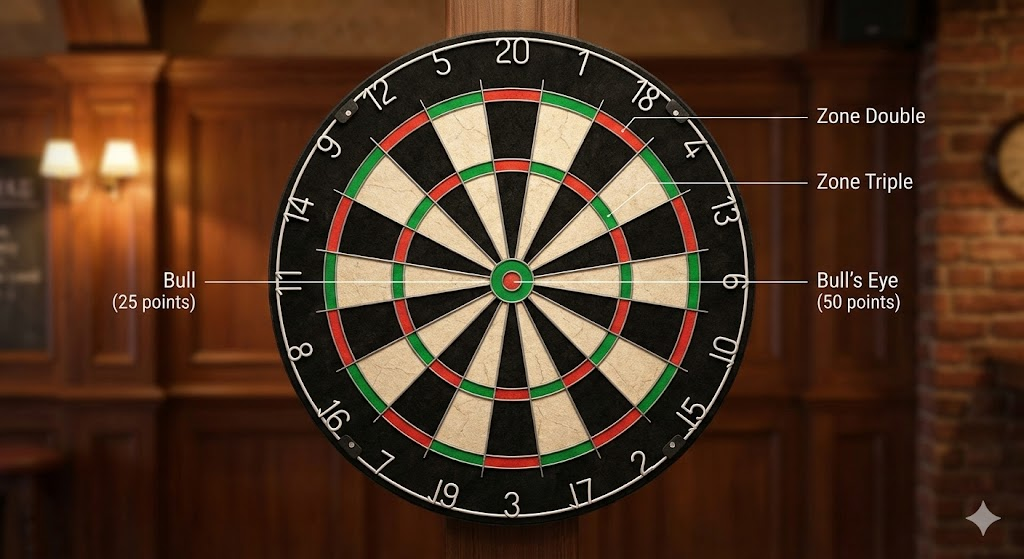
The scoring zones on a standard dartboard.
- The bull: the red dot in the middle is worth 50 and counts as a double. The green ring around it (the outer bull, or "25") is worth 25.
- The double ring: the thin band on the outside edge of the scoring area. Land here and the segment value doubles.
- The treble ring: the thin band halfway between the bull and the edge. Land here and the value triples. This is where big scores come from — three trebles in the 20 gives you a maximum of 180.
- The singles: the big black and white areas. Whatever number's printed on the outside, that's what you score.
How a Leg Is Played
1. The bull-off
To decide who throws first, both players throw a single dart at the bull. Closest to the middle starts. If both hit or both miss cleanly, you throw again.
2. The visit
Players alternate. A visit is your three darts at the oche. Once all three have landed, the score is added up and subtracted from your total. Then it's the other player's turn.